
Why is the TikTok Ban Still Present in Some Countries 2026?
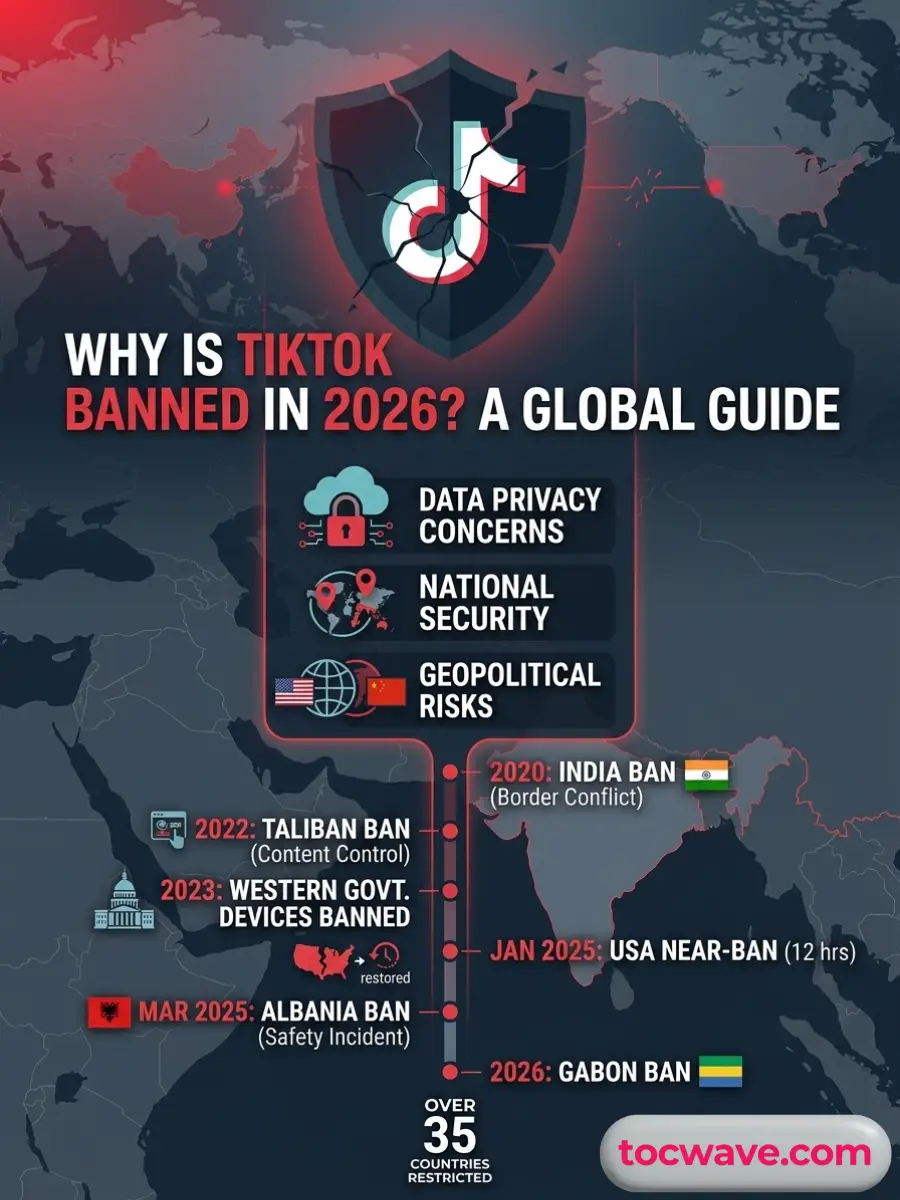
If you have opened TikTok recently and found out you can not go live, post, or even download the app, you are not alone. As of 2026, TikTok ban is fully or partially imposed in over 35 countries, and millions of creators and viewers have lost access to the platform with little warning.
This guide breaks down exactly why governments keep banning TikTok, which countries have restricted it, what happened during the near-ban in the United States in January 2025, and what people in banned regions are using to stay connected.
If you are looking for secure platform downloads, update packages, or alternative platform guides beyond this restriction analysis, you can access our main portal:
Why is the TikTok ban present in 2026?
TikTok is banned in several countries primarily because they view ByteDance, TikTok’s Chinese parent company, as a national security risk. Concerns center on data privacy, potential surveillance of citizens, content manipulation, and geopolitical tensions between China and Western nations. During 2026, full bans are in effect in India, Afghanistan, Nepal, Albania, and others.
The five core reasons governments cite are:
The real reasons governments TikTok ban
These are the prominent reasons behind TikTok banned countries:
1. Data privacy and the ByteDance problem
The biggest concern, raised consistently by governments from Washington to New Delhi, is where your data actually goes. TikTok collects a remarkable amount of information: location data, browsing history, device identifiers, biometric data, and behavioral patterns from how you scroll. The worry is that ByteDance, as a Chinese company, could be required to hand it over to Beijing under China’s 2017 National Intelligence Law.
TikTok has repeatedly denied this charge. In response to growing pressure, the company launched Project Texas, a $1.5 billion initiative to store all US user data on Oracle cloud servers, managed by a specially created entity called USDS (US Data Security). Despite this, many lawmakers remained unconvinced.
TikTok has repeatedly denied this charge. In response to growing pressure, the company launched Project Texas, a $1.5 billion initiative to store all US user data on Oracle cloud servers, managed by a specially created entity called USDS (US Data Security). Despite this, many lawmakers remained unconvinced.
2. National security and the espionage debate
Beyond data privacy, intelligence agencies in the US, UK, and EU have raised a more alarming possibility: that TikTok’s algorithm itself could be weaponized. The concern is that ByteDance engineers in China could, in theory, adjust what content gets amplified or suppressed for users in specific countries, essentially shaping public opinion at scale without anyone noticing.
This is not purely hypothetical. In 2022, ByteDance employees were found to have accessed data of US journalists to identify their sources. The incident intensified calls for TikTok ban and directly influenced the legislation that followed in the United States.
Sudden app disconnects are often tied to these rolling infrastructure changes or silent ISP rollouts. If you suddenly lose your stream connection mid-day, check our real-time diagnostic guide on why is my TikTok not working today to rule out local server throttling.
3. Content moderation and cultural standards
Several countries, particularly in South Asia and Central Asia, have cited TikTok’s failure to adequately moderate content that they view as culturally inappropriate, immoral, or dangerous to minors. Pakistan has banned and unblocked TikTok multiple times, each time pointing to sexually explicit or blasphemous content that the platform failed to remove quickly enough. Nepal, Indonesia, and Bangladesh have all issued similar complaints at various points.
4. Geopolitical tensions and tit-for-tat tech policy
TikTok banned scenario of 2020 in India has been the largest in its history, affecting 200 million users overnight. It came directly after a deadly border clash between Indian and Chinese troops in the Galwan Valley. The ban had nothing to do with data privacy rather it was a political signal. This pattern of using tech bans as geopolitical tools has become more common, with restrictions often escalating during periods of diplomatic tension between countries and China.
5. Digital sovereignty and tech nationalism
A quieter but growing motivation behind TikTok bans is the concept of digital sovereignty. An idea that a country should control its own digital infrastructure and not depend on foreign-owned platforms that it cannot regulate. This philosophy has driven EU legislation like the Digital Services Act (DSA), which places strict accountability requirements on large platforms, and has given smaller nations a framework to justify restricting foreign apps.
This philosophy has driven strict EU policy mandates under the newly enforced Digital Services Act rules via the European Commission, which demands explicit operational transparency from massive online platforms regarding their core algorithmic models.
TikTok ban timeline from 2020 to 2026
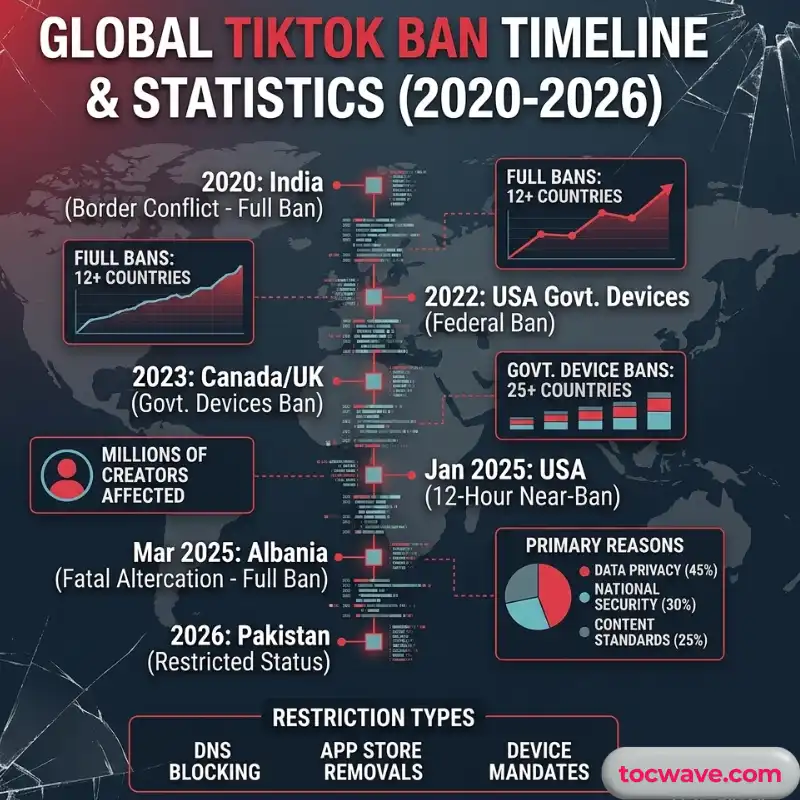
The story of TikTok restrictions is not a simple one. It is a rolling series of bans, reversals, legal battles, and last-minute postponements. Here are the moments that mattered most:
|
Year |
Country |
What Happened |
|---|---|---|
|
2020 |
India |
Full nationwide ban after Galwan Valley border clash. Affected 200M+ users. Ban remains in place. |
|
2020 |
Pakistan |
First of four bans. Cited immoral content. Restored after TikTok compliance commitments. |
|
2022 |
EU (Institutions) |
EU Parliament, Commission, and Council banned TikTok on staff devices citing cybersecurity risks. |
|
2022 |
USA (Federal Devices) |
Congress passed legislation banning TikTok on all US government devices. |
|
2023 |
UK |
Government banned TikTok on ministerial and civil servant devices. |
|
2023 |
Canada, Belgium, Denmark |
Government-device bans enacted across multiple Western governments. |
|
2023 |
Nepal |
Nationwide ban imposed citing social harmony concerns. |
|
Aug 2024 |
Nepal |
Ban partially reversed after TikTok agreed to content moderation framework. |
|
Jan 2025 |
USA |
PAFACA law took effect; TikTok went dark for ~12 hours before restoration pending court review. |
|
Mar 2025 |
Albania |
Full nationwide ban imposed after a teenager was killed in a TikTok-linked altercation. |
|
2026 |
Pakistan |
Ongoing restricted status with periodic throttling and content-level filtering by PTA. |
|
2026 |
Gabon |
Full ban implemented citing political instability and misinformation concerns. |
TikTok banned countries list 2025-2026
Below is the current breakdown of TikTok ban status by restriction category:
|
Year |
Country |
Primary Reason |
2026 Status |
|---|---|---|---|
|
2020 |
India |
Geopolitical (border tensions) |
Full ban, no access |
|
2022 |
Afghanistan |
Content control (Taliban regime) |
Full ban |
|
2023 |
Somalia |
Content moderation / security |
Full ban |
|
2023 |
Kyrgyzstan |
Cultural / content concerns |
Full ban |
|
Ongoing |
Iran |
Government censorship regime |
Blocked (like all Western apps) |
|
Ongoing |
North Korea |
Internet access banned nationwide |
No access |
|
Mar 2025 |
Albania |
Child safety / social harm |
Full ban (under review) |
Countries with government-device restrictions only
These countries have not applied TikTok ban for general citizens but prohibit it on government-issued phones and devices:
Countries with partial or recurring bans
What actually happened with the US TikTok ban 2025?
The United States came closer to a full TikTok ban than most people realised.In April 2024, the administration codified the Protecting Americans from Foreign Adversary Controlled Applications Act into law, setting off an unprecedented constitutional face-off regarding cross-border corporate governance and consumer speech protection.
ByteDance did not divest. On January 19, 2025, the day the law took effect, TikTok went offline in the United States for approximately 12 hours. Tens of millions of users found the app inaccessible. Then, in an unexpected move, President-elect Donald Trump announced he would issue an executive order delaying enforcement, and the app came back online.
As of mid-2026, the legal situation remains unresolved. The app is accessible, ByteDance has not sold TikTok’s US operations, and the underlying law is still being challenged in federal courts. The US is technically in a state of suspended enforcement, TikTok could go dark again if the political or legal calculus shifts.
How governments actually enforce TikTok ban?
DNS blocking and ISP-level filtering
The most common enforcement method is ordering internet service providers to block the DNS entries associated with TikTok’s domains. This means when your phone tries to connect to TikTok’s servers, the request goes nowhere. It is effective for casual users but straightforward to bypass with a VPN or alternative DNS server.
App store removals
More impactful than DNS blocking is pressuring Apple and Google to remove TikTok from their regional app stores. India did this in 2020, and it is the most effective enforcement mechanism for ensuring new users can not install the app at all. Users who had already installed TikTok before the removal often found the app stopped functioning or updating.
Government-device mandates
The softer version of a ban, common in Western democracies, involves prohibiting TikTok on government-issued devices without restricting access for the general public. These measures are largely about optics and managing the risk that the data of government employees could be accessed by ByteDance, while avoiding the political backlash of a full ban.
How does the TikTok ban specifically affect TikTok live?
Most coverage of TikTok bans focuses on the app in general, but TikTok live faces additional restrictions that go beyond what affects regular video posting. Here is why:
Why is TikTok live restricted in more places than the main app?
TikTok live is treated differently from regular TikTok content for several reasons:
Even in countries where TikTok is nominally accessible, TikTok live can be unavailable.
How TikTok live APK bypasses regional restrictions?
TikTok Live APK refers to the Android application package file for TikTok’s live streaming functionality. This is a version of the app that can be installed directly on Android devices without going through the Google Play Store.
App store bans new installations but they do not affect APK files that are downloaded and installed directly. When a country like India removed TikTok from the Play Store and geo-blocked the servers, it eventually stops working.
In such cases, you would need a VPN for TikTok or similar tool to route your connection. But for countries where the server access is still technically available, the APK can restore functionality.
If your primary app store has completely blocked updates or installations in your region, you can safely navigate around this restriction by utilizing an authentic TikTok Live APK download to restore your broadcasting features immediately.
ByteDance response as Project Texas and data localisation
Facing existential pressure from Western governments, ByteDance has not simply accepted the political heat. Its primary response in the United States was Project Texas, a $1.5 billion effort to restructure how US user data is stored and managed.
Under this project, all data from US TikTok users is stored on Oracle’s cloud servers in the United States. A new entity called USDS (US Data Security) aims to manage it under the staff predominantly comprising US nationals. ByteDance engineers in China are supposed to have no access to this data.
TikTok has repeatedly denied this charge. In response to growing pressure, the company launched Project Texas, a $1.5 billion initiative to store all US user data on Oracle cloud servers, managed by a specially created entity called USDS (US Data Security). Despite the massive structural scale of this initiative, independent corporate investigations documented in official CNBC technology reports reveal that deep skepticism remained regarding the structural firewalls separating international user databases, leaving lawmakers completely unconvinced.
TikTok alternatives in restricted regions
Users in countries where TikTok ban is fully imposed have generally migrated to one of these platforms:
Instagram reels
the most common migration destination; wide reach but lower organic discovery for new accounts
YouTube shorts
strong monetisation program; better for creators already established on YouTube
Moj and Josh
India-specific short video apps that gained 100M+ users after TikTok’s 2020 ban
Likee
popular in Southeast Asia and the Middle East as a TikTok substitute
Kwai
particularly strong in Brazil and parts of Africa
Snapchat spotlight
rowing as a live and short-video alternative in Western markets
While global platforms like Reels offer alternative monetization options, creators looking for specialized regional growth can check our verified breakdown of top TikTok alternatives tailored specifically for highly restricted zones.